
The Trade-Off That Disappeared
Pick a phone case for looks, and you might as well wrap your device in tissue paper. Pick one for protection, and you’re carrying a brick. For years, we accepted that compromise. According to our analysts, the market segmentation was brutal—fashion houses made accessories, and engineers made tackle boxes.
That trade-off is dead.
Walk into any coffee shop today, and you’ll see it. People aren’t hiding their phones inside thick rubber hides. They’re showing them off. The device is part of the outfit. But here’s the thing: nobody’s walking around with cracked screens either. The maths changed.

What ‘Protection’ Actually Means Now
The Hidden Damage
We used to think a phone case just needed to stop glass from shattering. That’s old thinking. Today’s phones pack delicate components that matter more than the screen. Optical stabilisers in cameras. Antenna traces. Solder joints on the charging port.
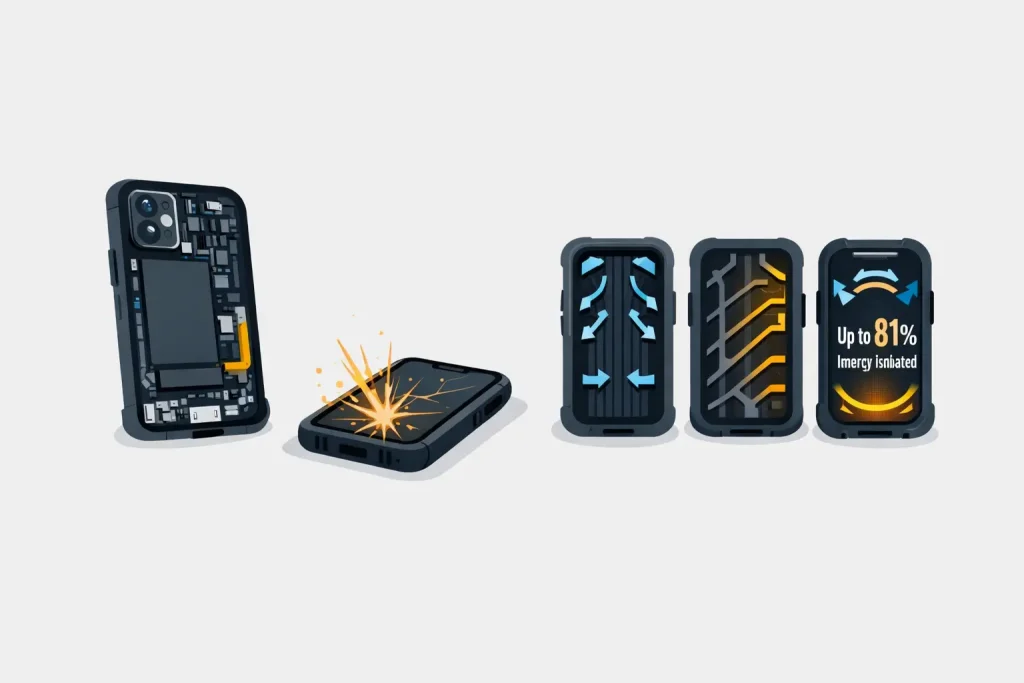
We’ve taken devices apart after drops where the glass survived. Dead inside. Micro-vibrations from impact can knock a camera sensor out of alignment or crack a solder point you’ll never see. A case that only stops screen damage? It’s doing half the job.
Shock Absorption Science
So we studied how to absorb energy, not just block it. The breakthrough came from thinking about milliseconds. If a phone case can delay impact shock by even a few milliseconds, the physics change. Force gets redirected. Air-filled channels inside the case structure. Internal ribs that shunt energy sideways. Not marketing gimmicks.
One brand we track isolated impact by up to 81% compared to standard rugged cases. Not through thickness. Through smarter engineering. That’s the kind of thinking that matters when you fumble your phone on concrete.
The Style Reality
Almost Invisible Protection
Here’s where it gets interesting. Some of the strongest cases we’ve tested are also the slimmest. Material science plus obsessive design.
Take the Arc Pulse. It looks almost ridiculous at first—just a bar across the top and bottom of the phone. You’d bet your pay cheque it wouldn’t work. We dropped a Pixel 9 Pro XL on concrete from head height. Six feet. Not once. A dozen times. The phone? Spotless. The case protected the corners—where impact actually transfers—and the weight distribution meant it almost never landed flat on the glass.
Or consider the UAG Metropolis LT. Kevlar weave. Lightweight. Grippy without being sticky. Passes military-grade drop tests. Adds some bulk, sure—less than you’d think. Precise cutouts. Strong magnets for MagSafe. Feels premium because it is.
Modular Thinking
Some designers are questioning why a phone case has to be one thing. Mageasy’s Odyssey Ultra M lets you swap the corners. Need max protection for a hike? Screw on the beefy shock-absorbing corners. Heading to dinner? Swap for the slim ones. Twenty-five-foot drop certified when you want it. Pocket-friendly when you don’t.
That flexibility changes how you think about protection. It’s not a permanent state. It’s adjustable.
The Economics of Protection
People Pay for Safety
Look at the market. CASETiFY, selling phone case options from $300 to $700, hit $3.6 bn in revenue last year. Not a million. Billion.
People aren’t buying because they’re gullible. They’re buying because the maths works. A high-end phone costs over $1,000 now. Skimping on the thing that protects it? False economy.
The Disposable Problem
Here’s a stat that stopped us: the average user replaces their phone case every 4.3 months. Faster than people change their toothbrush. It tells you something—people treat cases as fashion but also as disposable.
The brands doing it right fight that. RhinoShield builds cases from mono-materials that are 30 times more durable than standard options. They don’t yellow. Don’t get brittle. You don’t throw them away. Better for your wallet. Better for the planet. They also meet food-grade non-toxic standards—important for something you hold against your skin for hours.
Testing Reality
Lab vs. Sidewalk
Military-grade certification (MIL-STD-810) is the baseline. Means a case survived certain drops from certain heights onto plywood over stainless steel. Controlled. Repeatable.
Real life isn’t.
You drop your phone on a kerb. On gravel. On a tile edge. The best cases account for this. Multi-layer construction—hard outer shell to disperse force, soft inner core to absorb it. Raised edges around the camera and screen aren’t just for show. That millimetre gap can mean the difference between a scratch and a shattered lens.
Extreme Standards
Some cases now advertise protection from 25 feet. That’s legitimately extreme. Dropping your phone off a second-storey balcony. Most of us don’t need that. But the engineering trickles down. Hollow corner structures. Shock-dispersing materials. Makes everyday cases better too.
What We Recommend
Stop looking for the perfect phone case. It doesn’t exist. Start looking for the perfect trade-off for your life.
- If you drop your phone getting out of the car and occasionally on the sidewalk, you don’t need a brick. You need something slim with 3X military-grade protection. OtterBox Symmetry fits. Lightweight. Pocketable. Colours that don’t scream “safety first”.
- If you work outdoors, or you’re genuinely clumsy, go multi-layer. Defender Series. UAG. Something with port covers to keep dust out.
- If you hate cases entirely but aren’t an idiot, try the Arc Pulse. Minimalism taken to its logical extreme. Protects the right parts. Trusts the phone’s own glass to handle the rest. Pair it with a good screen protector.
Bottom Line
A phone case isn’t just an accessory anymore. It’s insurance. It’s fashion. It’s a statement about whether you value the thing in your hand enough to keep it working.
The good news? You don’t have to choose between looking good and being smart. The engineering caught up. Slim, stylish, and strong is the standard now. Not the exception.
According to our data, the only bad choice is buying cheap plastic that yellows in three months and cracks on the first drop. Just throwing money away. Spend a little more. Protect a lot more. Your phone will thank you.